Automate Sticky Notifications with Keyboard Maestro « Thank You For Your Cooperation

Automate Sticky Notifications with Keyboard Maestro « Thank You For Your Cooperation

http://brandonpittman.net/2012/11/automate-sticky-notifications-with-keyboard-maestro/


Automate Sticky Notifications with Keyboard Maestro


I bought Sticky Notifications a few weeks back and couldn’t think of much use for it. I was thinking today that it might be a good idea to take flagged items from Omnifocus and have them on the desktop as sticky notifications so that I make sure I don’t forget about them.


via Pocket http://brandonpittman.net/2012/11/automate-sticky-notifications-with-keyboard-maestro/


August 11, 2013 at 05:31PM

Must Download: Pixel Perfect Precision Handbooks by Ustwo | inspirationfeed.com


Pixels are the building blocks of all the visual design. If you’re a designer, I’m sure you’ve heard of the term ‘pixel perfect.’ This phrase is used to describe visual perfection of every last pixel. Blurred edges and color mismatches are common mistakes made by newbies. These kind of errors distract the user, leaving them with a poor impression.

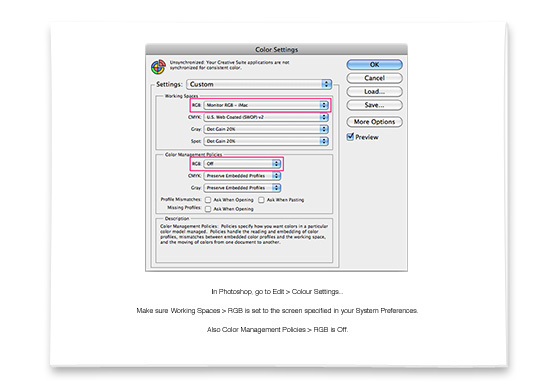
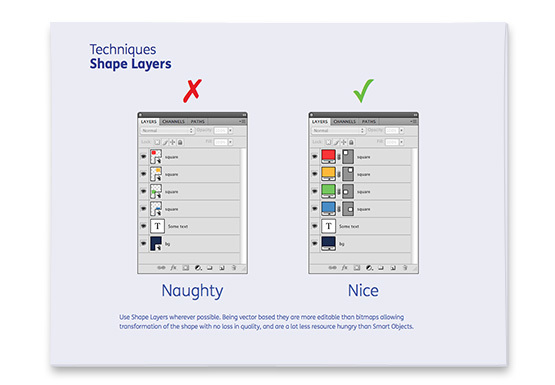
Ustwo is an independent digital design studio that serves clients across the globe. Showing endless love towards the design community, they produced the Pixel Perfect Precision Handbook. This handbook covers core Photoshop principles, disciplines, resources, tricks, shortcuts, tips, and much more.

The PDF was originally released back in March, and they recently released a second version. If you’re an upcoming designer, these informative handbooks will catapult your learning. The best part is that they’re 100% free. The first handbook is 106 pages, and the second one is 163. Don’t worry, this guide is image heavy and very simple to follow. The concise descriptions are short and straight to the point.

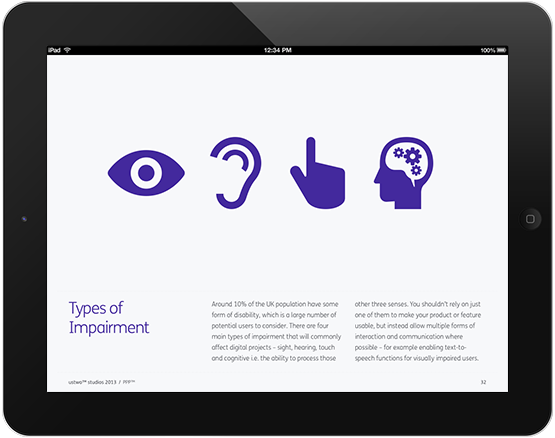
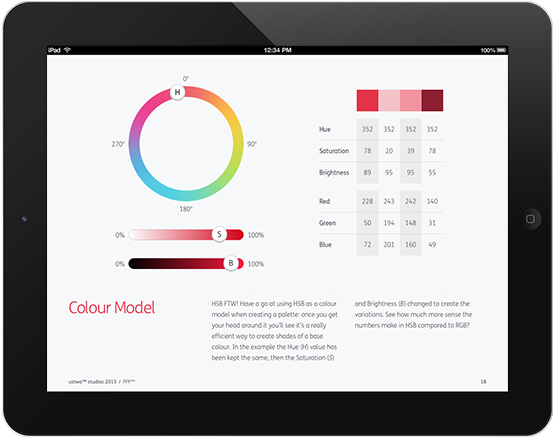
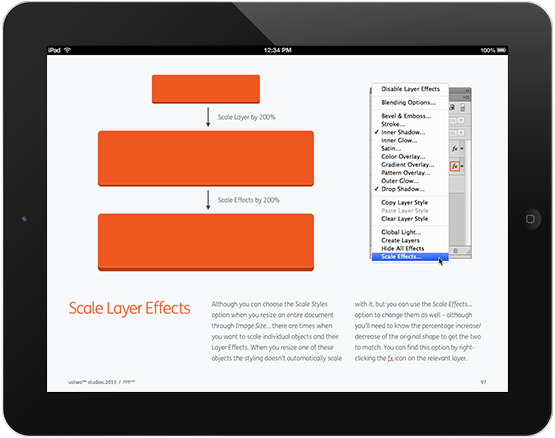
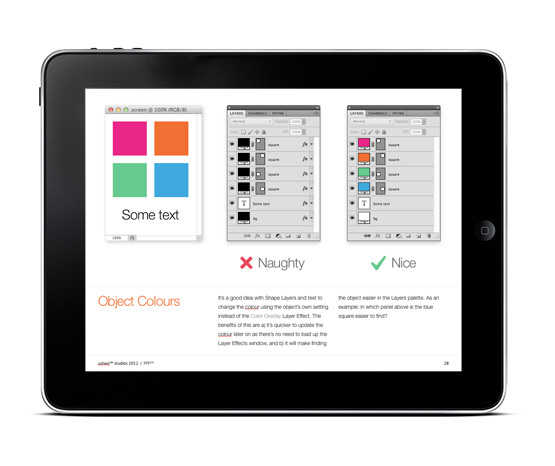
Below we’ve provided the download links as well as a few screenshots to give you an idea of how the handbooks look. Even if you’re not a beginner, they’re are worthy of your storage space. Enjoy!

Igor Ovsyannykov is a 20 year old geek, blogger, and designer. He mostly spends his time working here and sharing resourceful knowledge with others. He also enjoys weight lifting, hanging out with friends, and losing his mind to progressive house music. If you would like to reach him, send him an email to inspirationfeed@yahoo.com


The Bed Book: Sylvia Plath's Poems for Kids, Illustrated by Quentin Blake | Brain Pickings

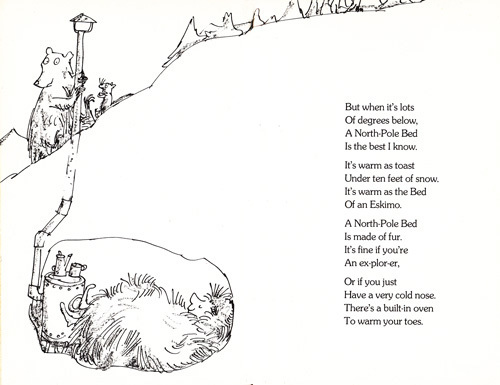
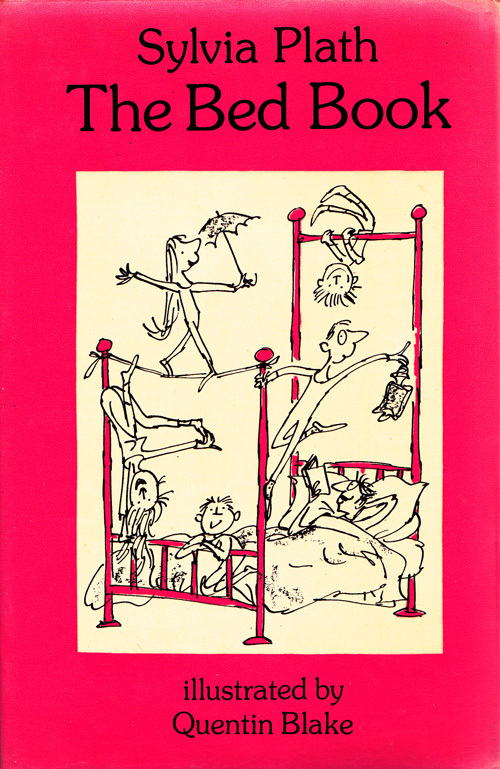
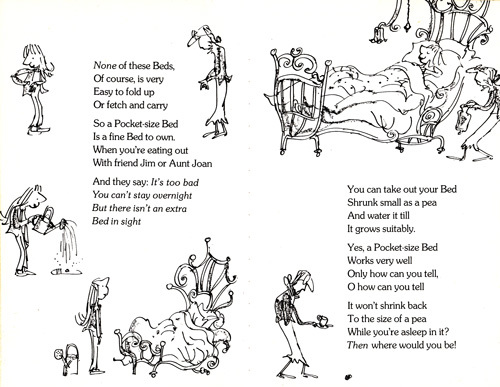
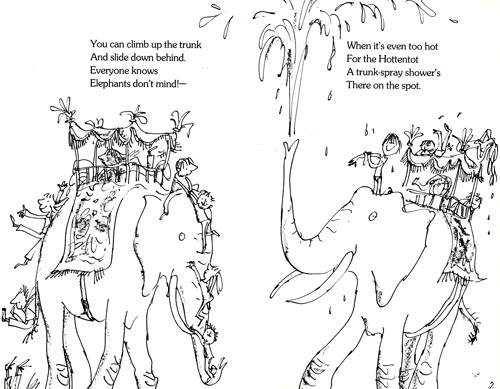
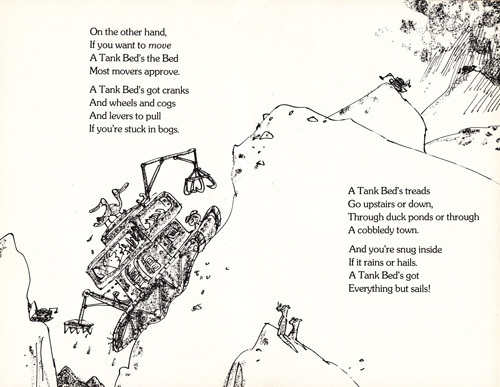
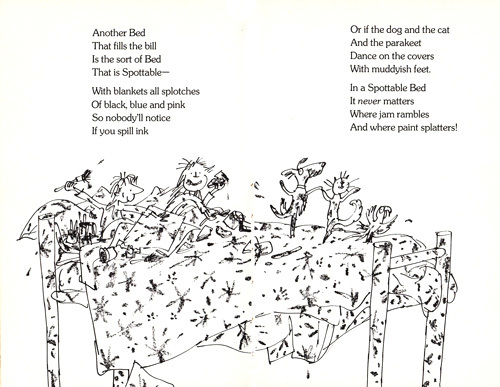
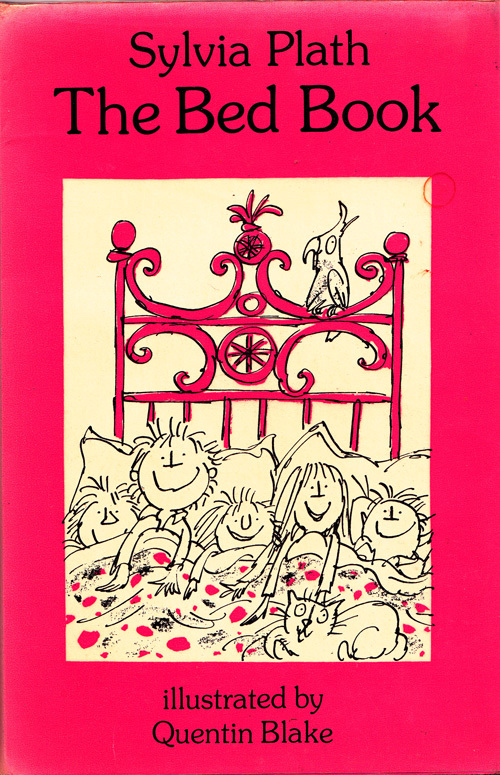
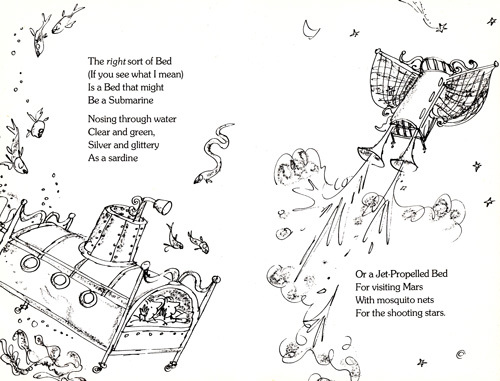
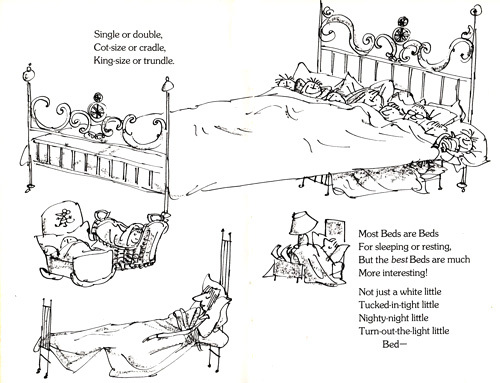
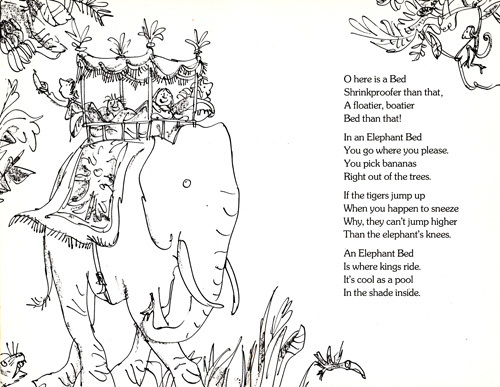
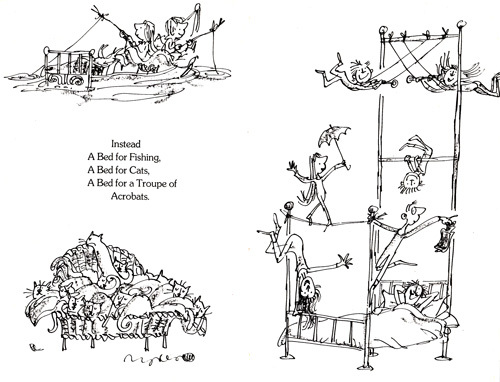
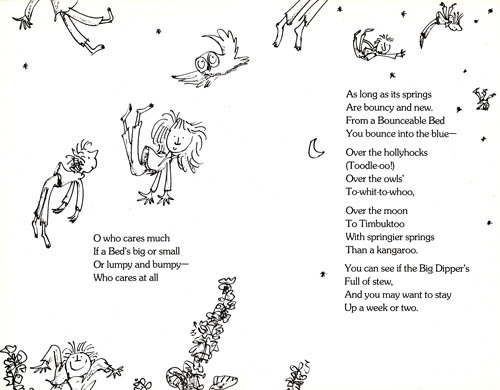
The Bed Book: Sylvia Plath’s Vintage Poems for Kids, Illustrated by Quentin Blake

“Most Beds are Beds for sleeping and resting, but the best Beds are much more interesting!"

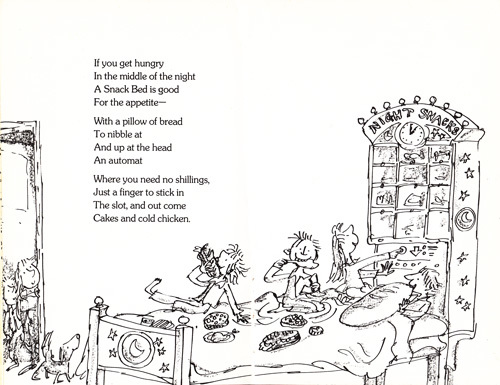
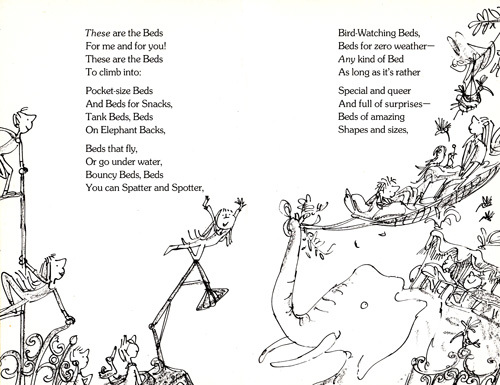
In 1959, Sylvia Plath — celebrated poet, little-known artist, lover of the world, repressed “addict of experience", steamy romancer — penned a lovely children’s story about the perils of self-consciousness. But it turns out it wasn’t her only: In 1976, Faber published The Bed Book (public library) — a series of fanciful poems about different kinds of beds, written for Plath’s own children, sprinkled with fantasy and escapism. The original British edition, of which I was fortunate to track down a copy, was illustrated by the celebrated and prolific children’s book artist Quentin Blake, best-known for illustrating Roald Dahl’s stories as well as the first Dr. Seuss book not illustrated by Seuss himself.

Alas, the American edition, published in 1989 by HarperCollins, did away with the Blake illustrations — but used copies of the British one can still be found online or borrowed at some libraries.

Complement The Bed Book with other lesser-known children’s books by literary titans, including William Faulkner, James Joyce, Mark Twain, Virginia Woolf, T. S. Eliot, Mary Shelley, Leo Tolstoy, Oscar Wilde, Aldous Huxley, Gertrude Stein, James Thurber, Carl Sandburg, Salman Rushdie, Ian Fleming, and Langston Hughes.

Donating = Loving

Bringing you (ad-free) Brain Pickings takes hundreds of hours each month. If you find any joy and stimulation here, please consider becoming a Supporting Member with a recurring monthly donation of your choosing, between a cup of tea and a good dinner:

You can also become a one-time patron with a single donation in any amount:

Brain Pickings has a free weekly newsletter. It comes out on Sundays and offers the week’s best articles. Here’s what to expect. Like? Sign up.


Facial Recognition Technology And Drones - Business Insider

60 Minutes, CBS

Lesley Stahl on 60 Minutes

PITTSBURGH (AP) — The Tsarnaev brothers, like anyone in a crowd of strangers, might have expected to be anonymous.

But when the FBI released blurry, off-angle images of the two suspects in the Boston Marathon bombings, researchers with Carnegie Mellon University’s CyLab Biometrics Center began trying to bring them into focus.

In a real-time experiment, the scientists digitally mapped the face of “Suspect 2," turned it toward the camera and enhanced it so it could be matched against a database. The researchers did not know how well they had done until authorities identified the suspect as Dzhokhar Tsarnaev, the younger, surviving brother and a student at University of Massachusetts Dartmouth.

“I was like, ‘Holy shish kabobs!’ " Marios Savvides, director of the CMU Cylab, told the Tribune-Review. “It’s not exactly him, but it’s also not a random face. It does fit him."

The technology, to be sure, remains in its infancy. Yet cyber experts believe it’s only a matter of years — and research dollars — until computers can identify almost anyone instantly. Computers then could use electronic data to immediately construct an intimate dossier about the person, much of it from available information online that many people put out there themselves.

From seeing just the image of a face, computers will find its match in a database of millions of driver’s license portraits and photos on social media sites. From there, the computer will link to the person’s name and details such as their Social Security number, preferences, hobbies, family and friends.

Adding that capability to drones that can fly into spaces where planes cannot — machines that can track a person moving about and can stay aloft for days — means that people will give up privacy as well as the concept of anonymity.

“We are accustomed to living in a society where our movements are not tracked from place to place, and it’s a big shift to have that happen," said Jennifer Lynch, staff attorney with the Electronic Frontier Foundation, a San Francisco-based nonprofit that works to protect digital rights and privacy.

“There’s so much data about us in different places that it’s absolutely impossible to keep track of it or to delete it. … Adding facial recognition capabilities to that will destroy anonymity and will create a pretty big chilling effect on how we feel about moving about in society and the choices we make in our lives."

‘DECODING THE FACE’

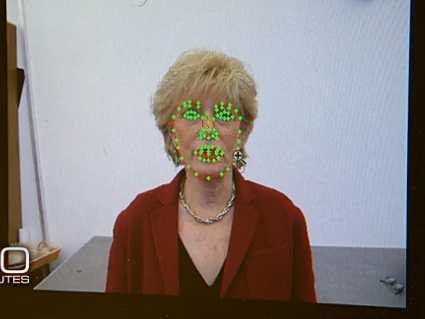
Inside the CyLab at Carnegie Mellon, an off-the-shelf drone with four rotors spins about the room. As it does, a camera looks into each face and sends images to a computer that dissects them into distinct markers that can be matched against a database.

Students working with Savvides are figuring out how to break up appearance into landmarks as unique as a fingerprint and to build a 3-D image from a single picture so it can be matched from different angles.

“The things we can do are endless," said Savvides. “We’re basically decoding the face."

For now, the database holds only the images of lab workers and visitors who agree to participate. Savvides said he can envision a day when images collected by tiny cameras embedded in police cruisers and attached to officers’ uniforms are matched against a database of wanted criminals. As soon as a driver looks into a rear-view mirror to see an officer pulling up, the person’s face could be matched.

That technology does not exist, but the students have built a camera that collects facial identifiers from as far as 60 feet away.

Funded by the Department of Defense’s Biometrics Identity Management Agency, the camera could be mounted to the entry point of a military base or embassy to identify visitors before they’re close enough to attack.

“We want to push the distance of biometric capture," said Travis McCartney, a project manager with the federal agency in Fairmont, W.Va. “How can we identify folks from longer ranges for purposes of security and to keep our personnel out of harm’s way?"

Taken steps further using tiny drones that can fly over public areas and link to databases from social media sites, the technology might sweep down any American street and identify almost anyone instantly. Facebook users upload 2.5 billion images a month, but the company limits public access.

A separate research team at CMU has conducted experiments that matched photos of students on campus with their Facebook profiles — and then predicted their interests and Social Security numbers.

But when the researchers tried matching surveillance photos of Tsarnaev with the known photos of him released later, the computer had a hard time detecting similarities. Alessandro Acquisti, a professor of information technology at CMU’s Heinz College, worked on the experiment and faulted the distance and poor quality of the surveillance equipment.

Technological hurdles such as that are falling away, he said. Every year, camera phones offer better lenses and higher resolutions.

DATABASES GROWING

The databases of identified images grow with the help of social media and retail sites in which users upload their images to try on virtual glasses or hairstyles. Rather than seeking a match among department of motor vehicles portraits, searchers might access dozens of photos from varied angles and settings.

Computational power is growing, too. Scanning through millions of photos with commercial computers takes hours, but government agencies have access to more powerful systems.

“It could happen in the not-so-distant future, and from a behavior perspective, it does raise important/creepy/exciting kinds of questions," Acquisti said.

Not to worry, said Nita Farahany, a Duke University law professor who specializes in digital privacy. The U.S. Constitution will keep the government from peering into homes, and state laws block Peeping Toms.

Market forces, she added, should limit corporations.

“Who will safeguard us against the ubiquitous collection of data by corporations?" Farahany asked. “If the goal of those companies is really to gather information to more precisely target advertisements and product offers to would-be consumers, maybe we have a lot less to worry about than people fear."

___

Online:

http://bit.ly/11WaTqX


Undercover Manila Laptop Sleeve | GeekAlerts

April 21, 2011

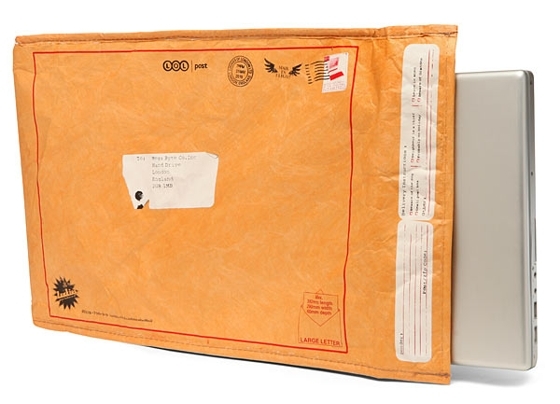
Just last week, my sister’s laptop was stolen right from under her nose. It was tucked into her trusty old black laptop bag which she placed beside her chair at the diner. The next thing she knew, it was gone. It was unfortunate but I’m pretty sure it probably wouldn’t have happened had she been using the Undercover Manila Laptop Sleeve. Not only is it as creative as laptop sleeves can get, but it also adds an another layer of protection for your laptop.

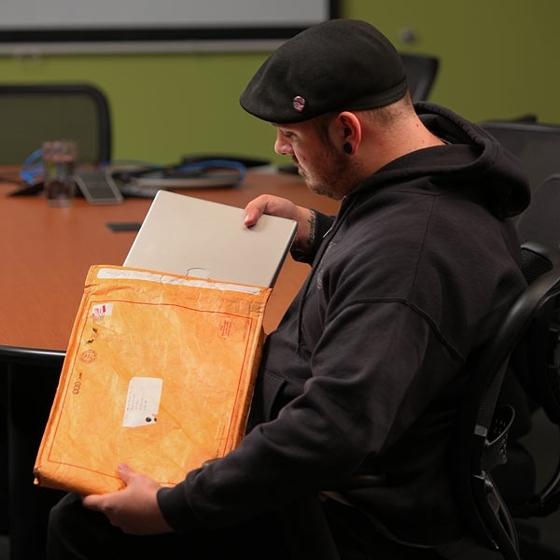
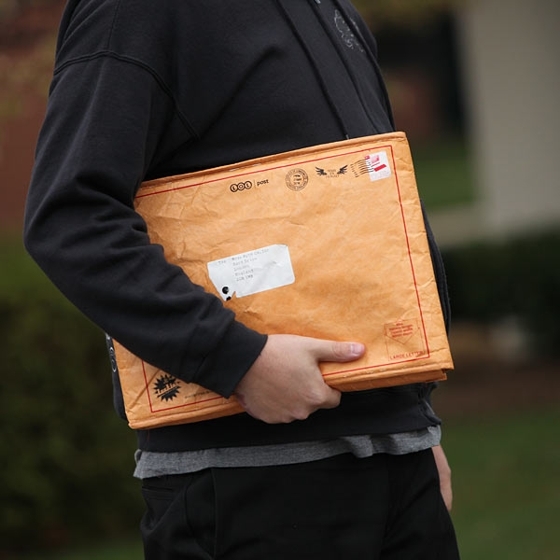
The Undercover Manila Laptop Sleeve looks like a wrinkly envelope that was handled pretty roughly at the post office. It’s also something that thieves and crooks looking for a quick pay day probably won’t stop to check because their sights are set on the things that look valuable at the outset: the leather briefcase or the laptop bag at the corner.

You can secure that bag with a ball and chain, for all it matters, but what do you do when the whole bag or sleeve is taken? The Undercover Manila Laptop Sleeve secures your notebook by obscurity; nobody would even think for a second that what’s actually in the ratty envelope is your top-of-the-line laptop.

  • Tough tear-resistant and splash-proof tyvek exterior
  • Holds any laptop from 8 inches to 17 inches
  • Strong Velcro strips hold your laptop in place
  • Inner lining PE foam construction pads your laptop
  • Hide your laptop in plain sight!

You can get the from ThinkGeek for $29.99.


Foxy Brown and Jackie Brown - Fonts In Use

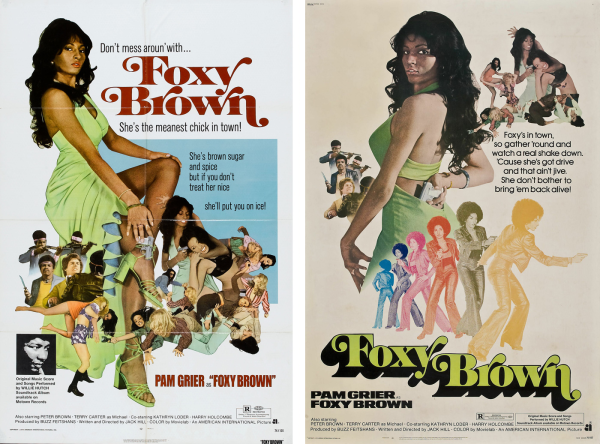
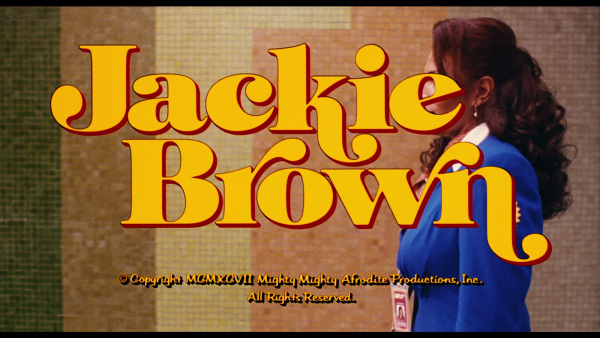
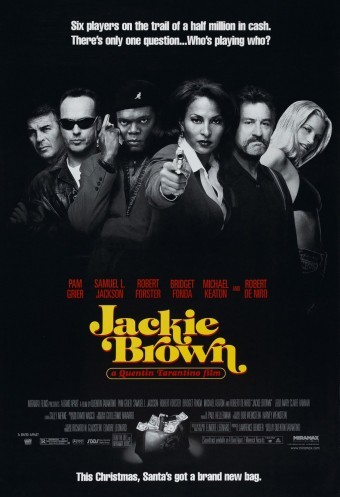
Quentin Tarantino’s 1997 film, , starring Pam Grier, is an homage to the blaxploitation genre of the 1970s. The film’s name — and its logotype treatment, used prominently in the feature’s promotional materials and opening titles — is a direct reference to Pam Grier’s 1974 film, .

The basis of the Jackie Brown logo is ITC Tiffany, designed by Ed Benguiat in 1974. (More of ITC Tiffany can be seen in the Collector’s Edition DVD packaging.) But the swash ornamentation that gives the logo its funky distinction (see ‘k’, ‘B’, ‘r’, ‘w’, ‘n’) is inspired by other exaggerated display serifs of the phototype era. The chief reference is likely another Benguiat design, Caslon Black Swash (AKA Benguiat Caslon), which was used for the Foxy Brown promotional material (below). Incidentally, the prolific Ed Benguiat is also the artist responsible for the lettering of the famous Superfly logo.

Below the Jackie Brown title, “a Quentin Tarantino Film" is set in Goudy Heavyface, Lanston Monotype’s response to the popularity of Cooper Black.

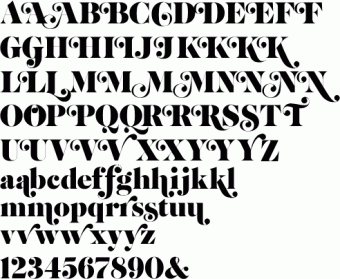
Various online sources mistakenly identify the Foxy Brown type as Cabernet, but that’s not accurate as Jason Walcott’s face is purely digital, a 2003 interpretation of Benguiat’s Caslon. This kind of misattribution is commonly made these days, overlooking metal or photocompositor typefaces that haven’t been digitally released under their original name. I’m as guilty of this as anyone and I’m gradually wising up as I learn more about analog type. Still, from a practical view, it’s certainly useful to know what fonts can be used today that emulate the pre-digital work.

This image from Daylight Fonts is labeled as Benguiat Caslon but appears to be Cabernet, with its additional swashes created by Jason Walcott. Some of these were probably inspired by the custom modifications that PLINC made to order.

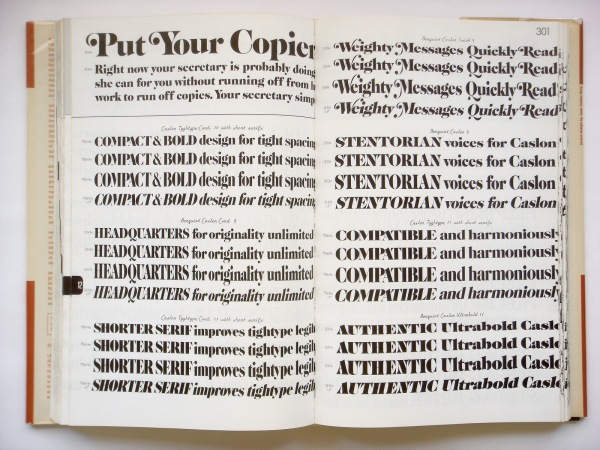
The most official digital version of Benguiat Caslon is now available through Photo-Lettering.com, House Industries’ revival of the 1950–80s film font service that lets you set a line of type and pay for just that set of words rather than the font itself. For customers, the advantages of this system is a much lower cost of entry, and effects like shadows and fills are easier to apply.

Seeking to keep Benguiat Caslon as close to the original as possible, restorer Christian Schwartz digitized everything on the film font source and added very few new glyphs. This means it lacks many of the extra swashes (particularly lowercase) found in Cabernet. Most of these appear to be Walcott’s own inventions inspired by the custom modifications that were often made by PLINC lettering artists upon their customers’ requests. Another, less refined, digital tribute is Emfatick NF.

Update: The initial version of this article asserted that the Benguiat Caslon available at PhotoLettering.com was not complete. Christian Schwartz, who was responsible for that digitization, corrected me and reminded me that custom modifications to film fonts were common:

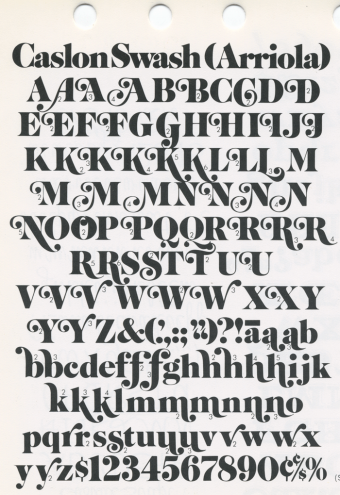
Caslon Swash (Arriola) as shown in the 1980 catalog of Phil’s Photo. The design is not credited.

At PLINC, the films were really just a starting point, and the lettering artists there would modify and add alts and swashes as they saw fit, or as the art director speccing the type would request. The ‘r’ from the Foxy Brown logo, for example, was probably drawn just for the logotype.

I’ve updated the article to reflect this.

It’s also possible that the designers used a font from another provider. Knockoffs and followers were as common in phototype as they are today. At right is a scan of a very similar font called Caslon Swash (or Arriola) from the 1980 catalog of Phil’s Photo, Homage to the Alphabet. It includes all the variations found in Foxy Brown and Cabernet, and then some. That’s not to say that all of the wacky extensions are good ideas, or even very well drawn. The alt ‘O’, for example, is particularly shoddy. I can hear someone from the back of the room yelling, “Fo-cus!".