Saturday Night Live - YouTube
Published by deputat on October 8th, 2013

Published by deputat on October 8th, 2013
Published by deputat on October 7th, 2013
Published by deputat on October 3rd, 2013
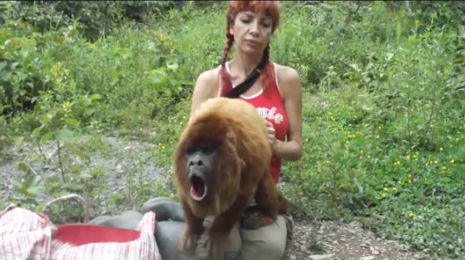
Apparently the monkeys are “famous for their loud howls, which can travel three miles through dense forest."
Via Boing Boing
comments powered by Disqus
Published by deputat on October 1st, 2013
Published by deputat on October 1st, 2013
Published by deputat on September 29th, 2013
Published by deputat on September 24th, 2013
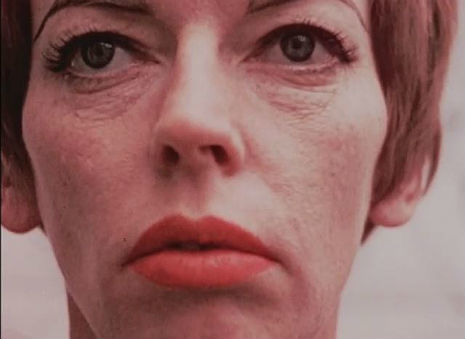
Until The Wormwood Star came out on DVD and Blu-ray recently via Drag City/Flicker Alley as part of The Curtis Harrington Short Film Collection, it was very, very scarce and very difficult to see. You either had to be a friend of Curtis Harrington, probably, or have had a mutual friend with the late director (that’s how I saw it) or maybe see it in a museum. Now it’s on YouTube, of course.
So we’ve established that’s it’s, er, Angery, meaning that there’s more than a fair share of visual flair, drama and a hefty dollop of authentic occult creepiness. Cameron, for those who don’t know, was the wife of rocket scientist/wannabe Antichrist Jack Parsons and a participant in the infamous “Babalon Working" magical rite that also involved future Scientology founder L. Ron Hubbard. She was a dedicated follower of Aleister Crowley and his occult philosophy of Thelema (“Do what thou wilt shall be the whole of the Law").
Curtis Harrington told Cameron biographer Spencer Kansa in his book, Wormwood Star: The Magickal Life of Marjorie Cameron:
Before I made the film I’d heard from Renate [referring here to painter Renate Druks] that Cameron had spent some time in the desert trying, through magical means, to conceive a child by the spirit of Jack Parsons without success. Cameron never spoke of Jack directly, but I do remember feeling sometimes when I talked to her, of her going off into a realm that I didn’t understand at all. It was sort of an apocalyptic thing and it’s there in her poetry.
What you should know as you watch this is that the vast majority of Marjorie Cameron’s paintings were destroyed by her—burned—in an act of ritualized suicide. There are very few pieces by Cameron that have survived—a few paintings and some sketches—and The Wormwood Star is the only record of most of them (outside of the astral plane, natch. What does survive of her estate is represented by longtime New York gallerist Nicole Klagsbrun). Cameron has long been a figure of fascination for many people and I think I can say with confidence that this film meets or even far exceeds any expectations you might have for it.
As with Anger’s films, I deeply appreciate the careful aesthetic balance between beauty and evil and, as such, it’s an extraordinary document of both Marjorie Cameron Parsons’ very essence as a human being and of her creative output. As cinema, it’s a mini-masterpiece that can stand alongside any of Anger’s films, Ira Cohen’s magnificently freaky Invasion of the Thunderbolt Pagoda, Jack Smith’s Normal Love or Yayoi Kusama’s Self-Obliteration.
Below, the seldom-seen short film, The Wormwood Star. If it looks this good on YouTube, it must look really amazing on Blu-ray. Order The Curtis Harrington Short Film Collection on Amazon (I just did).
Curtis Harrington and Cameron would work together again on 1961’s Night Tide, one of Dennis Hopper’s first starring roles. Her role as the “Water Witch" was brief, but oh so memorable…
Thank you Spencer Kansa, author of Wormwood Star: The Magickal Life of Marjorie Cameron
comments powered by Disqus
Published by deputat on September 21st, 2013
Support Slogger by contributing to my GitTip fund.
If you are upgrading from a version prior to 2.0.12, please remove the RSSLogger section from slogger_config and regenerate it by running slogger again. A new section will be added in addition to RSSLogger called Bloglogger. RSSLogger now logs all entries for the timespan as a single digest entry, whereas Bloglogger loads each item found as an individual "post."
Slogger indexes various public social services and creates Day One (http://dayoneapp.com/) journal entries or plain text Markdown files for them. It allows you to keep a personal journal that collects your online social life automatically, all in one place.
From the command line, change to the Slogger folder and run the following commands:
Default plugins are stored in /plugins/, additional plugins are usually found in /plugins_disabled/. Plugins are enabled and disabled by adding/removing them from the /plugins/ folder. Move any additional plugins you want to use into /plugins/ and disable any other plugins by moving them from /plugins/ to plugins_disabled. (Plugins that are found in plugins but not configured will not break anything, but you'll see warnings when run.)
From within the Slogger folder, run ./slogger --update-config to create the initial configuration file. If this doesn't work, you may need to make the file executable: chmod a+x slogger from within the Slogger folder. Note that any time you add new plugins or update existing ones, you'll want to run ./slogger --update-config to ensure that your available options are up to date.
Edit the file slogger_config that shows up in your Slogger folder
Edit additional configuration options for any plugins defined. The config file is formatted as YAML, and your options need to conform to that syntax. For the most part, you can just maintain the formatting (quotes, dashes, brackets, etc.) of the default settings when updating.
Next time you run ./slogger, it will execute the enabled and configured plugins and generate your journal entries.
./slogger to run the data
capture for the plugins you have in you /plugins/ directory. /plugins/ folder (if you don't need them).launchd scheduling app, or..../install.rb to automatically install a launchd task that will run at 11:50pm every night. It's the same as Lingon would create, but all free and stuff.
rm ~/Library/LaunchAgents/com.brettterpstra.slogger.plist and then log out and back in.Note: You can use the
-soption to only log since the last run date, handy if you want to run Slogger more or less than once per day or are testing plugins.You can also use
-oto run only a certain plugin in the standard plugin directory: just provide it with enough of the name to be unique, e.g.slogger -o gist.The
-u Xoption will undo the last X runs. This works by checking the timestamp of the run and deleting any entries created after that timestamp. It should not be used if you have manually created entries since the last Slogger run. It also does not remove the run timestamps from the list, so running./slogger -u 4will remove the entries created by the last four runs, and then running./slogger -u 5will undo one more run in history.
Slogger is currently actively maintained, meaning new fixes and features are regularly available. To update your Slogger installation, download the zip file for the latest version (the link on this page is always current) into a new folder. Copy the new files over existing files to update them. If you've enabled plugins that are disabled by default, you'll need to copy them from the new folder's "plugins_disabled" folder to your current "plugins" folder.
As long as you don't move or delete your slogger_config file, all of your settings will be preserved after the update.
More documentation coming. See plugin_template.rb to get started.
If you want to edit an existing plugin to change parameters or output, move the original to plugins_disabled and make a copy with a new name in plugins. It will make it easier to update in the future without losing your changes.
When developing plugins you can create a directory called 'plugins_develop' in the same folder as 'plugins' and work on new plugins in there. When you run slogger, use ./slogger -d to only run plugins in the develop folder while testing.
@log is a global logger object. use @log.info("Message") (or warn/error/fatal) to generate log messages using the default formatter.
@config is the global configuration object. Your plugin settings will be stored under @config[PluginClassName]. If you return the config object at the end of your do_log function, any modifications will be stored (e.g. for saving oAuth tokens).
$options contains options parsed from the command line. Use $options[:optionname] to read the setting.
:develop whether Slogger was run in develop mode:timespan the timespan passed from the command line as number of days (int):quiet suppresses log messages. This affects the log formatter and shouldn't generally be needed. Just create log messages using @log and if :quiet is true, they'll be suppressed.:retries is the number of retries to attempt on any given operation. Create loops in network calls and parsing routines to allow for retry on failure, and use $options[:retries] to determine how many times to iterate.@timespan is available to all plugins and contains a date object based on the timespan setting. This defaults to 24 hours prior to the run.
@date_format, @time_format and @datetime_format (this is just the conjunction of the first two) are available to all plugins and should be used wherever you output a date or time to DayOne files, e.g. Time.now.strftime(@date_format).
Slogger depends on Apple’s system Ruby version to run. You can check the Ruby version by typing ruby -v in your terminal, it should return something like ruby 1.8.7 (2012-02-08 patchlevel 358) [universal-darwin12.0].
Slogger does not currently support Ruby 1.9.x or 2.x.
If you are using RVM or RBENV to manage your Ruby installation, you can set the system Ruby as the default.
For RVM check here: https://rvm.io/rubies/default
For RBENV check here: https://github.com/sstephenson/rbenv#choosing-the-ruby-version
In order for Slogger to run you must have an up-to-date version of Xcode's Command Line Tools installed.
Simply download Xcode from the OSX App Store. When it has downloaded launch it, open "Preferences", and under "Downloads" select "Install" on "Command Line Tools".
If Slogger is running, but returning an error message, it may be an issue with a plugin configuration.
It may help to move all plugins to the Disabled Plugins directory, and then add them back into the Plugins directory one by one, running ./slogger each time to ensure it is not returning any errors. That way, you can identify if there is an issue with a particular Plugin.
Common issues with Plugins:
Feeds entered incorrectly. Multiple RSS feeds should be entered like
feeds: [http://feed1.com/feed1.rss, http://feed2.com/feed2.rss, http://feed3.com/feed3.rss]
Attempting to fetch an invalid feed. Feeds can be validated here: http://validator.w3.org/feed/
It's not uncommon to have some sync issues using iCloud. The developers of the Day One app explicitly favour using Dropbox to sync your journal between your Mac and iPhone or iPad. So maybe use Dropbox.
If you are using Dropbox, a common location for your Day One Journal, which will need to be entered in the Slogger Config file under "Storage" is /Users/YOURUSERNAME/Dropbox/Apps/Day One/Journal.dayone. Please note that if you have moved your Dropbox, to your Desktop for instance, that would change the path required to /Users/YOURUSERNAME/Desktop/Dropbox/Apps/Day One/Journal.dayone
By default Slogger sets the Date format to ISO 8601 (Y/m/d) "%F" and the Time format to H:M (24-hour clock) "%R". These settings can be changed to anything from the strftime specification, viewable here: http://linux.die.net/man/3/strftime.
The European Date format dd/mm/yy is not supported. The closest option is probably to set date to "%x" which is "The preferred date representation for the current locale without the time."
Slogger by Brett Terpstra is licensed under a Creative Commons Attribution-NonCommercial-ShareAlike 3.0 Unported License.
Hosted on GitHub Pages using the Dinky theme
Published by deputat on September 21st, 2013
Published by deputat on August 22nd, 2013
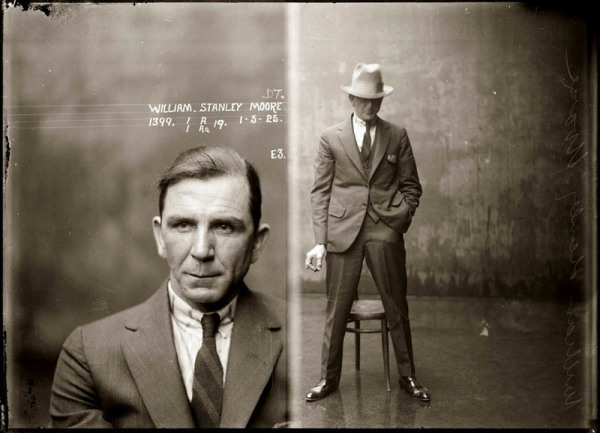
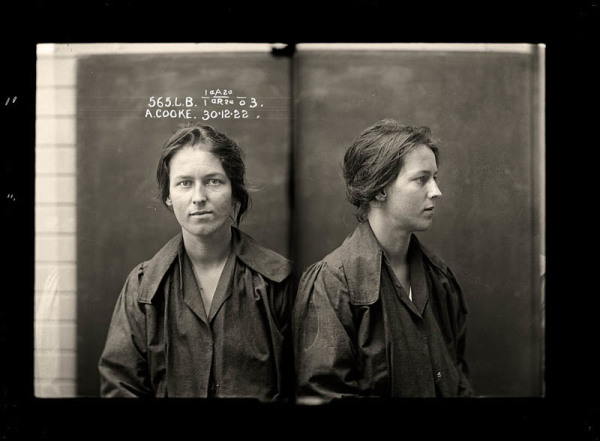
The Sifter recently stumbled upon an incredible collection of vintage mugshots housed by the Historic Houses Trust. Many of these intriguing photographs are also accompanied by a description of the person and the crime(s) they have committed. For example, the image above of Mr. William Stanley Moore was taken May 1st, 1925. The caption describes him as: an opium dealer operating with large quantities of faked opium and cocaine. Also a wharf labourer and associates with water front thieves and drug traders.
The images themselves are of excellent quality, beautifully composed and in many cases, quite artistic. Please enjoy this curated selection of 30 photographs along with brief descriptions of each when available.
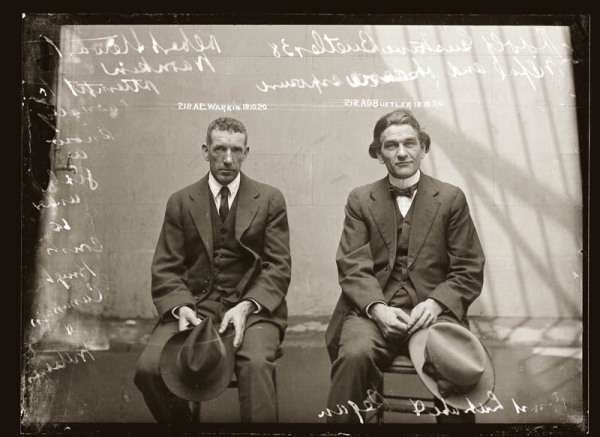
Albert Stewart Warnkin is listed in the NSW Police Gazette of 10 November 1920, as charged with attempting to carnally know a girl eight years old. No entry is found for Beutler, whose picture is inscribed ‘wilful and obscene exposure’.
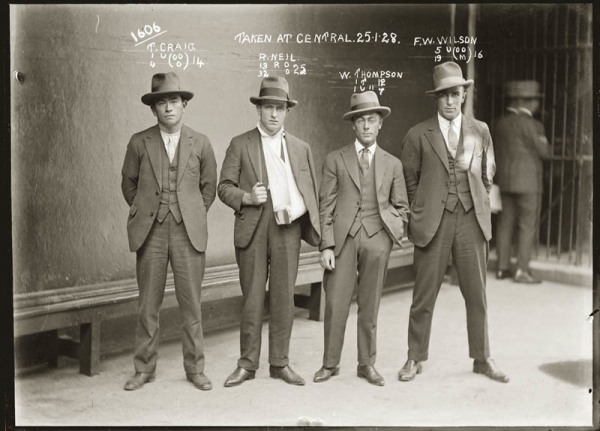
This photograph was apparently taken in the aftermath of a raid led by Chief Bill Mackay – later to be Commissioner of Police – on a house at 74 Riley Street, ‘lower Darlinghurst’. Numerous charges were heard against the 15 men and women arrested. It was a house frequented by ‘reputed thieves’.
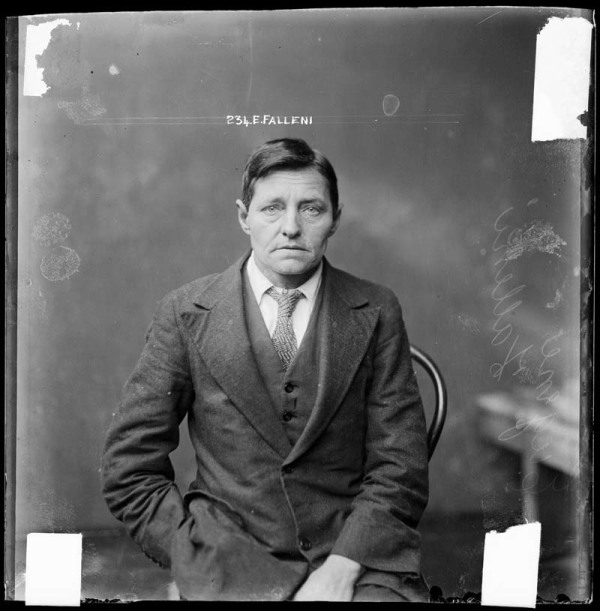
When ‘Harry Leon Crawford’, hotel cleaner of Stanmore was arrested and charged with wife murder he was revealed to be in fact Eugeni Falleni, a woman and mother, who had been passing as a man since 1899. In 1914, as ‘Harry Crawford’, Falleni had married the widow Annie Birkett. Three years later, shortly after she announced to a relative that she had found out ‘something amazing about Harry’, Birkett disappeared.
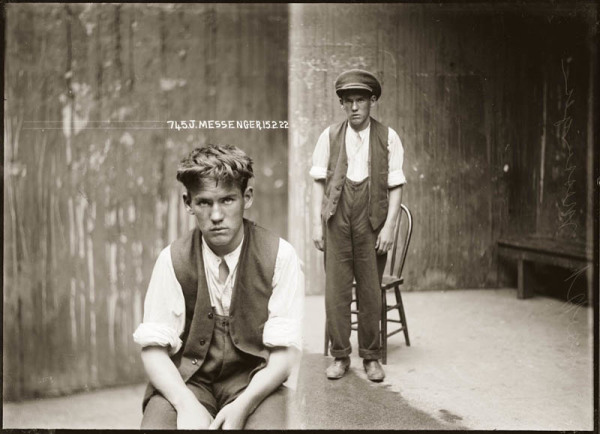
Joseph Messenger and Valerie Lowe were arrested in 1921 for breaking into an army warehouse and stealing boots and overcoats to the value of 29 pounds 3 shillings. The following year, when this photograph was taken, they were charged with breaking and entering a dwelling. Those charges were eventually dropped but they were arrested again later that year for stealing a saddle and bridle from Rosebery Racecourse. As an adult Messenger was active in inner-Sydney underworld through the 1920s, and he appears in the NSW Criminal Register (16 July 1930 entry no 171) as a seasoned criminal and gang affiliate.

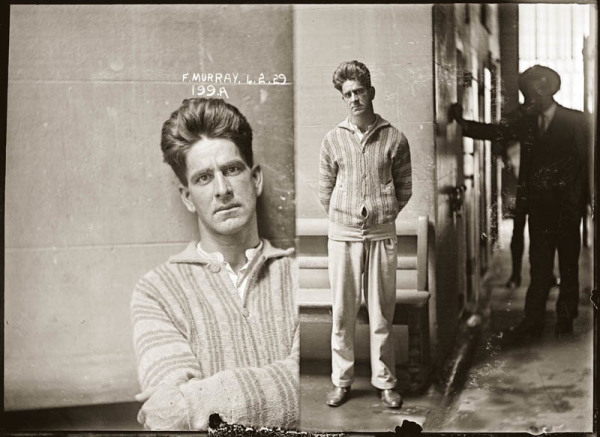
Harry Williams was sentenced to 12 months hard labour on March 1929 for breaking, entering and stealing. Although he ‘consorts with prostitutes’ and ‘frequents hotels and wine bars in the vicinity of the Haymarket’, he is described as being of ‘quiet disposition’.
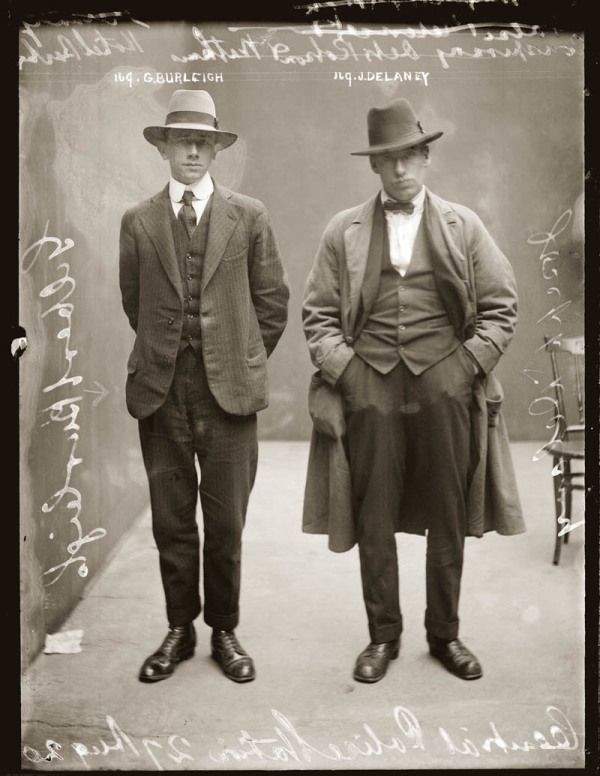
Gilbert Burleigh on the left is identified as a ‘hotel barber’, and Delaney’s picture is labelled ‘false pretences & conspiracy’. A companion photograph makes it clear that in fact Delaney was the hotel barber – meaning one who books into a hotel, boarding house or residential and robs (or ‘snips’) fellow patrons, usually in the dead of night
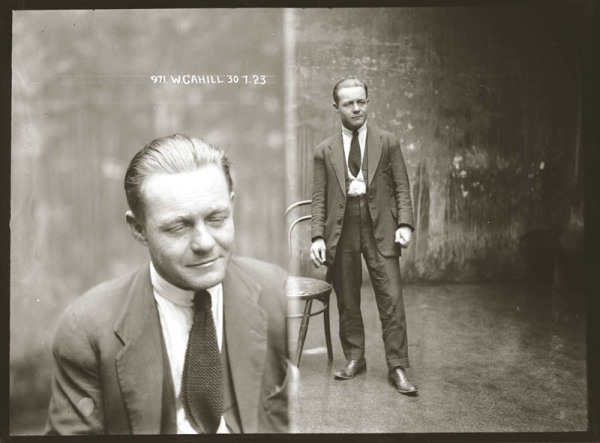
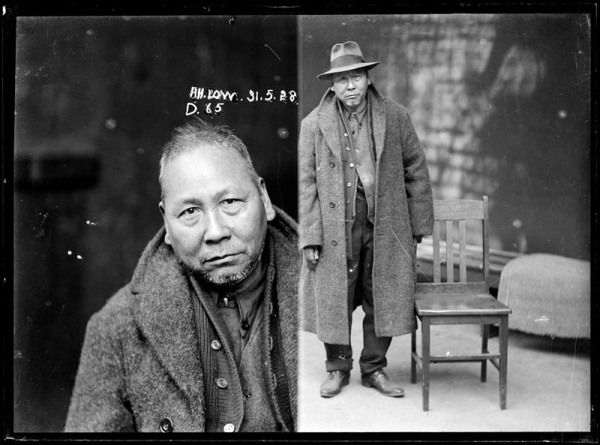
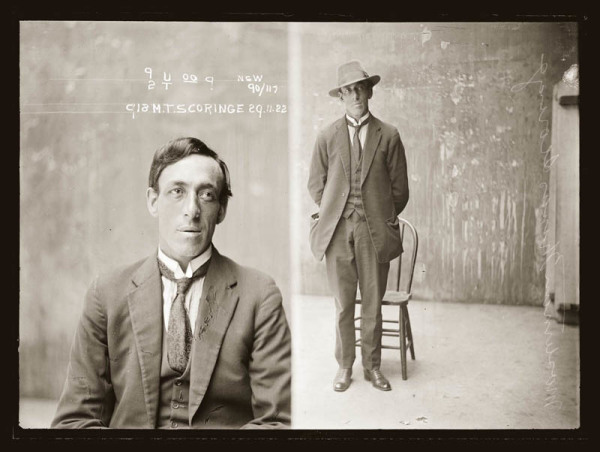
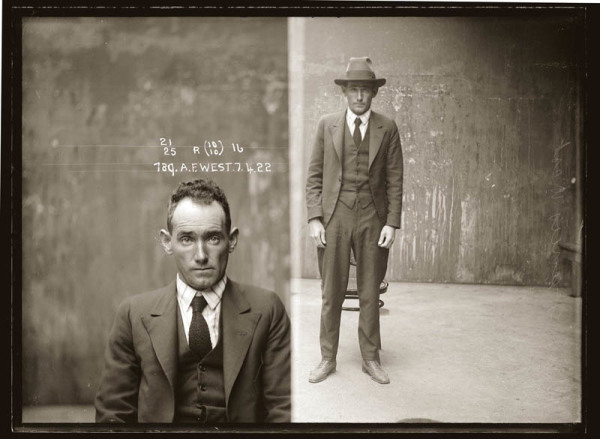
These pictures are from a series of around 2500 “special photographs" taken by the New South Wales Police Department photographers between 1910 and 1930. These “special photographs" were mostly taken in the cells at the Central Police Station, Sydney and are, as curator Peter Doyle explains, of “men and women recently plucked from the street, often still animated by the dramas surrounding their apprehension".
Doyle suggests that, compared with the subjects of prison mug shots, “the subjects of the Special Photographs seem to have been allowed – perhaps invited – to position and compose themselves for the camera as they liked. Their photographic identity thus seems constructed out of a potent alchemy of inborn disposition, personal history, learned habits and idiosyncrasies, chosen personal style (haircut, clothing, accessories) and physical characteristics."
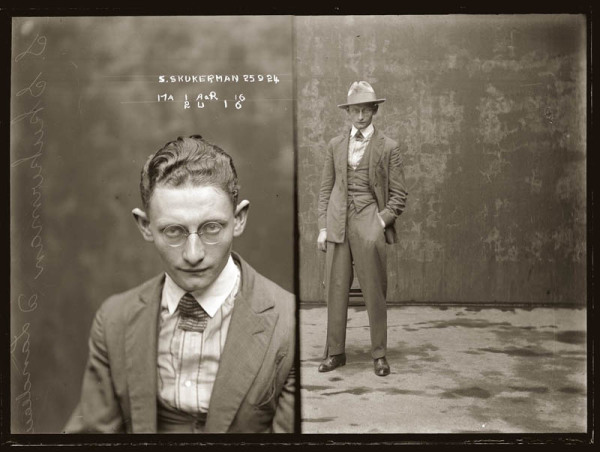
An entry in the Supplement to the NSW Police Gazette Sydney for Skukerman, (alias Kukarman, alias Cecil Landan) is captioned ‘obtains goods from warehousemen by falsely representing that he is in business’.
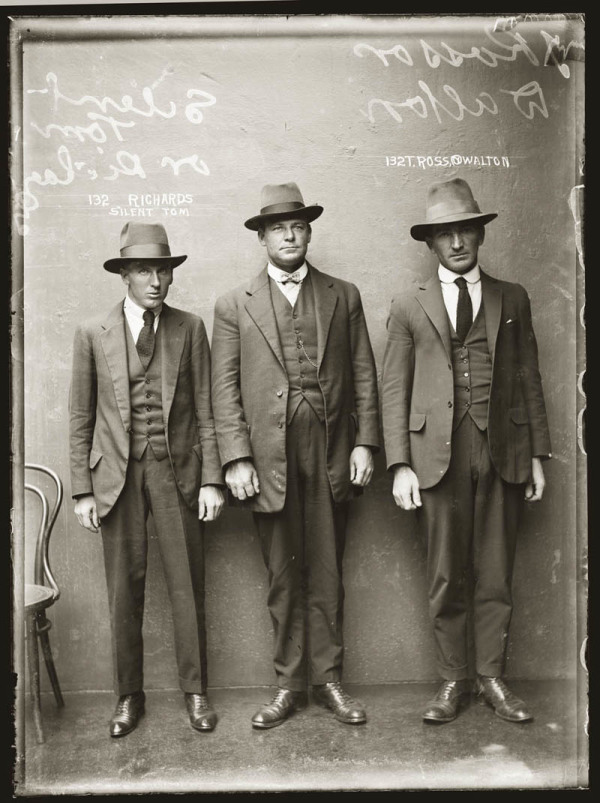

George Whitehall, carpenter, handed himself into Newtown police after hacking to death his common-law wife, Ida Parker on Thursday afternoon 21 February 1922, at their home in Pleasant Avenue, Erskineville. This photo was apparently taken the following morning at Newtown Police Station.

No entry for Fiori/Permontto is found in the NSW Police Gazette for 1924, although this photo appears in a later photo supplement, in which Fiori is described as a safebreaker.

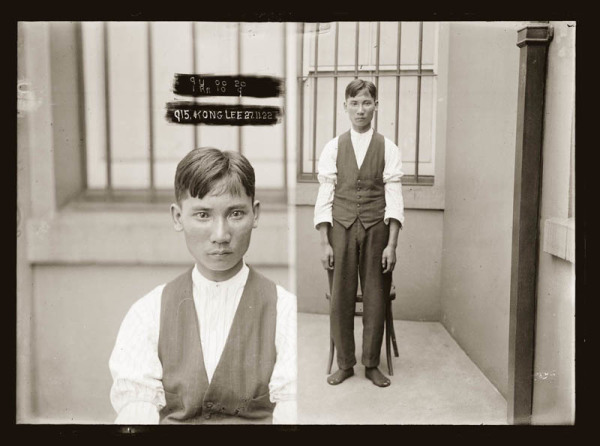
Kong Lee makes numerous appearances in the NSW Police Gazette as a ‘safe blower’ and ‘thief’, and is noted in the issue of February 1929 as having recently been seen riding trains ‘in the company of card sharpers and spielers’.
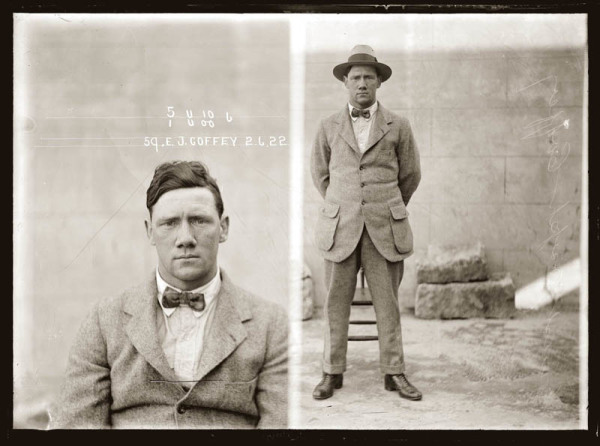
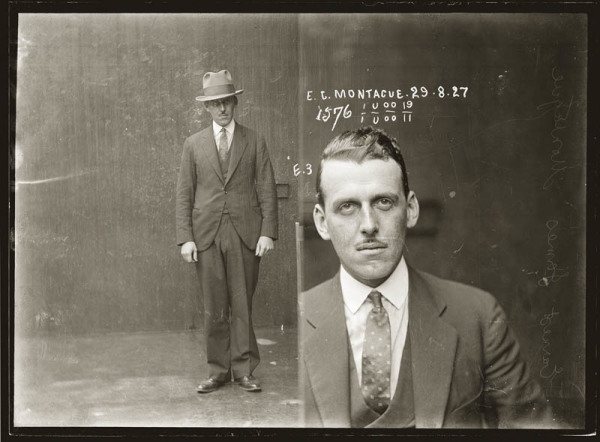

Walter Keogh appears in the Photo Supplement to the 1923 NSW Police Gazette (7 February Group 1 p. 4) identified as a pickpocket, and later in 1928 (26 December, Group 4 p. 15) as a ‘suspected person and bogus land salesman’. Keogh was also profiled in exposes in the newspaper Truth in 1928, as a ‘go-getter’, ie a con man who sells suburban building blocks at grossly inflated prices, by falsely leading the buyers to believe the lots may be promptly resold for a huge profit.
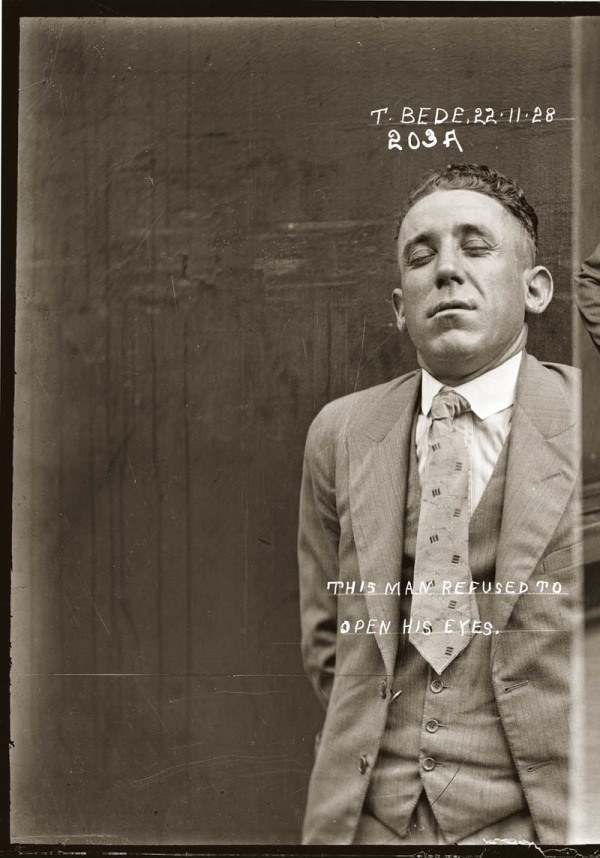
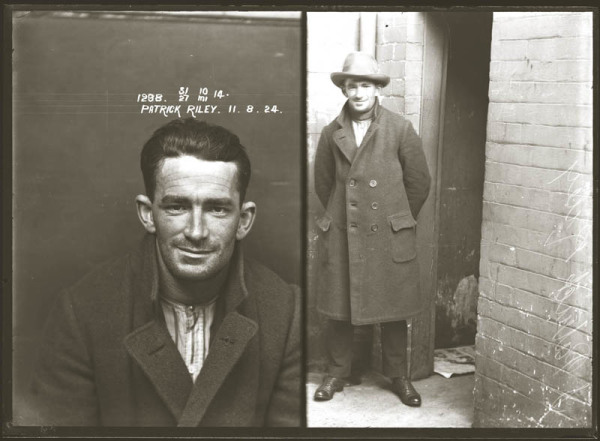
Patrick Riley (alias Matthew Edward Riley) was convicted in October 1924 of making counterfeit coins, and of having a coining instrument (ie a mould) in his possession, for which he was sentenced to two years imprisonment with hard labour.
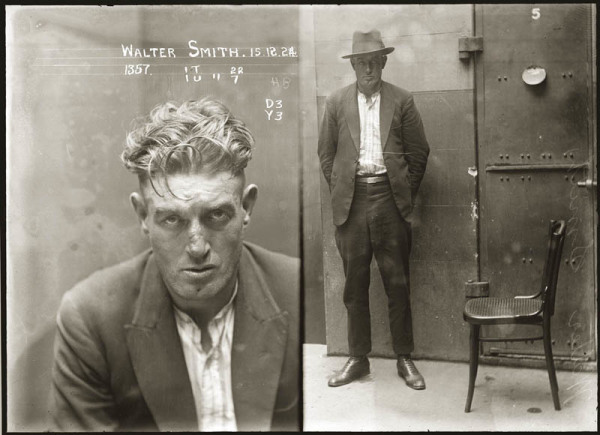
Walter Smith is listed in the NSW Police Gazette, 24 December 1924, as ‘charged with breaking and entering the dwelling-house of Edward Mulligan and stealing blinds with a value 20 pounds (part recovered)’, and with ‘stealing clothing, a value of 26 pounds (recovered) in the dwelling house of Ernest Leslie Mortimer.’ Sentenced to 6 months hard labour.
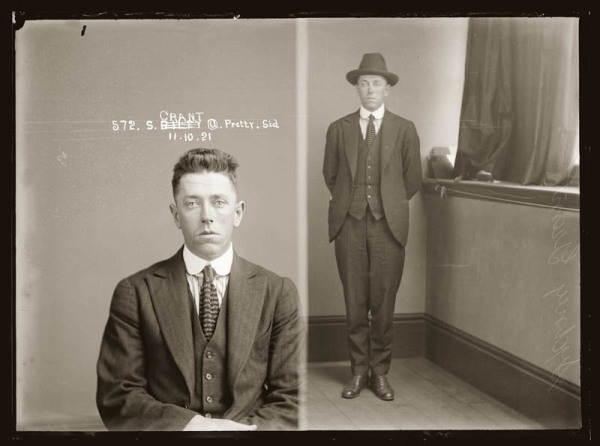
A picture of Sidney Grant (alias ‘Pretty Sid’) appears in the ‘Criminal Photographs’ section of the New South Wales Police Gazette, 2 May 1923 captioned ‘Confidence man (notes for gold)’. In his landmark sociological work, The Big Con (first published in 1940) David Maurer describes a con trick known as “the hot-seat", then being practiced in Europe by “such masters of their profession as Pretty Sid, Snowy T-, Kangaroo John, Melbourne Murray, Devil’s Island Eddie, Slab B[rennan] …" It was not unusual then for the most accomplished Australian con artists to seek fresh fields in Britain, Europe (especially France) and North America, where their skills were held in high regard by fellow professionals.

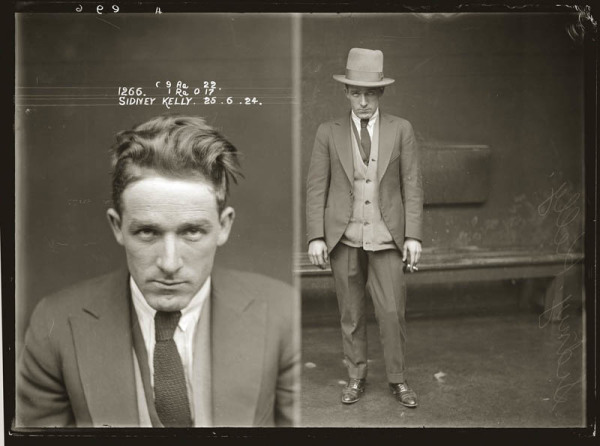
Details surrounding this particular photograph are unknown, but Sidney Kelly was arrested many times and much written about in newspapers during the 1920s, 30s and 40s. He was charged with numerous offences including shooting, and assault, and in the 1940s was a pioneer of illegal baccarat gaming in Sydney. This image appears in the Photo Supplement to the NSW Police Gazette, 26 July 1926, p. 6 captioned, “Illicit drug trader. Drives his own motor car, and dresses well. Associates with criminals and prostitutes."
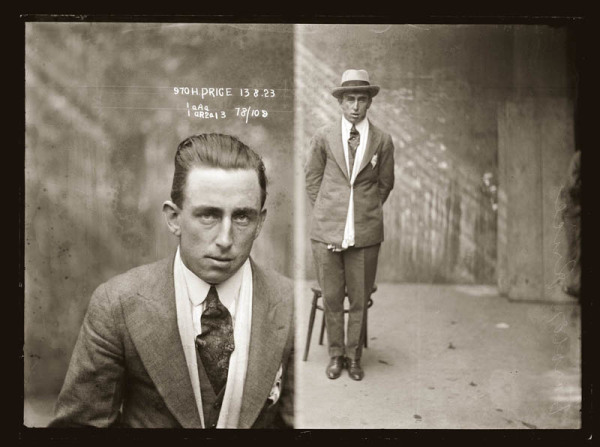
Harold Price was a thief and gunman. This photograph was taken after he was was arrested and charged with committing robbery under arms at a house in Randwick, Sydney, for which he was sentenced to two years hard labour.
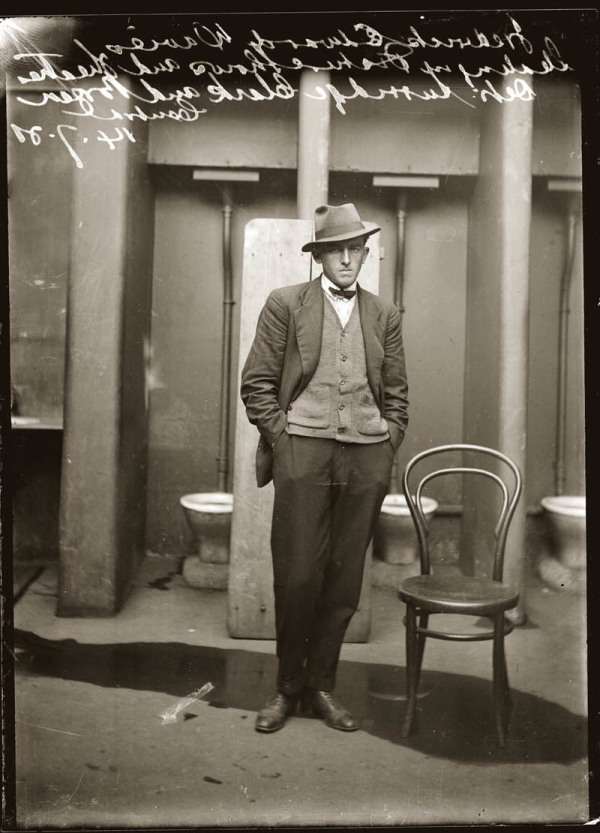
The handwritten inscription on this unnumbered Special Photograph reads ‘Frederick Edward Davies stealing in picture shows and theatres Dets Surridge Clark and Breen Central 14-7-21′. Police held sneak thieves in particularly low regard, which may account for the decision to photograph Davies in front of the police station’s toilet stalls.

The precise circumstances surrounding this picture are unknown, but Ellis is found in numerous police records of the 1910s, 20s and 30s. He is variously listed as a housebreaker, a shop breaker, a safe breaker, a receiver and a suspected person. A considerably less self-assured Ellis appears in the NSW Criminal Register of 29 August 1934 (no. 206). His convictions by then include ‘goods in custody, indecent langauge, stealing, eceiving and throwing a missile.
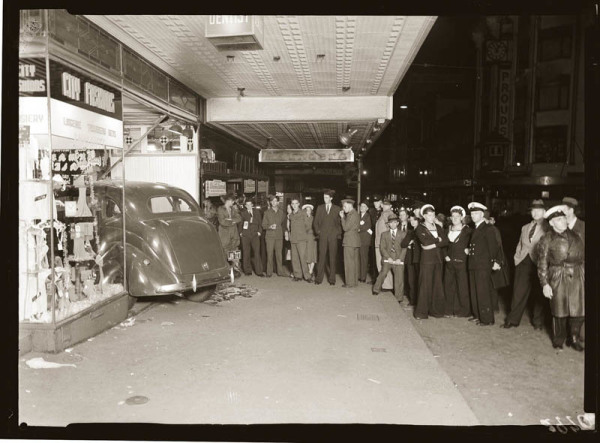
In 1990 the Historic Houses Trust rescued a remarkable collection of NSW Police forensic photographs from a flooded warehouse in Lidcombe. Created between 1912 and 1964, the archive contains approximately 130,000 glass plate negatives depicting crime scenes, police activities, forensic evidence and mug shots and may be the biggest police photography collection in the southern hemisphere. The Historic Houses Trust has the job of conserving, repackaging, digitising, researching and cataloguing the archives contents, for which original record systems have been lost.
Major exhibitions featuring the archive have travelled widely, including Crime Scene and Femme Fatale and two books have been produced City of Shadows and Crooks Like Us by Peter Doyle. Ongoing discoveries from the archive are regularly displayed within a dedicated in the Archive Gallery at the Justice & Police Museum. The current exhibition is Collision: Misadventure by Motorcar which depicts car crashes and traffic accidents between 1920 and 1960 as well as the changing streets of Sydney, developments in automobiles and the increasing involvement of police in traffic management.
The Historic Houses Trust continues to explore this fascinating archive, attaching stories to events, histories to scenes, and motives to seemingly inexplicable behaviours. More details about the archive and information about upcoming exhibitions can be found on the Historic Houses Trust website hht.net.au. The Justice & Police Museum is open daily 9.30am – 5pm, cnr Albert & Phillip Streets Circular Quay, General $10 | Concession $5 | Family $20, T 02 9252 1144, books available at shop.hht.net.au.